Guide · Personal Finance

How to Start a Side Hustle With Zero Capital

By Yinka Olayokun Published Updated 5 min read Reviewed by Yinka Olayokun
Share
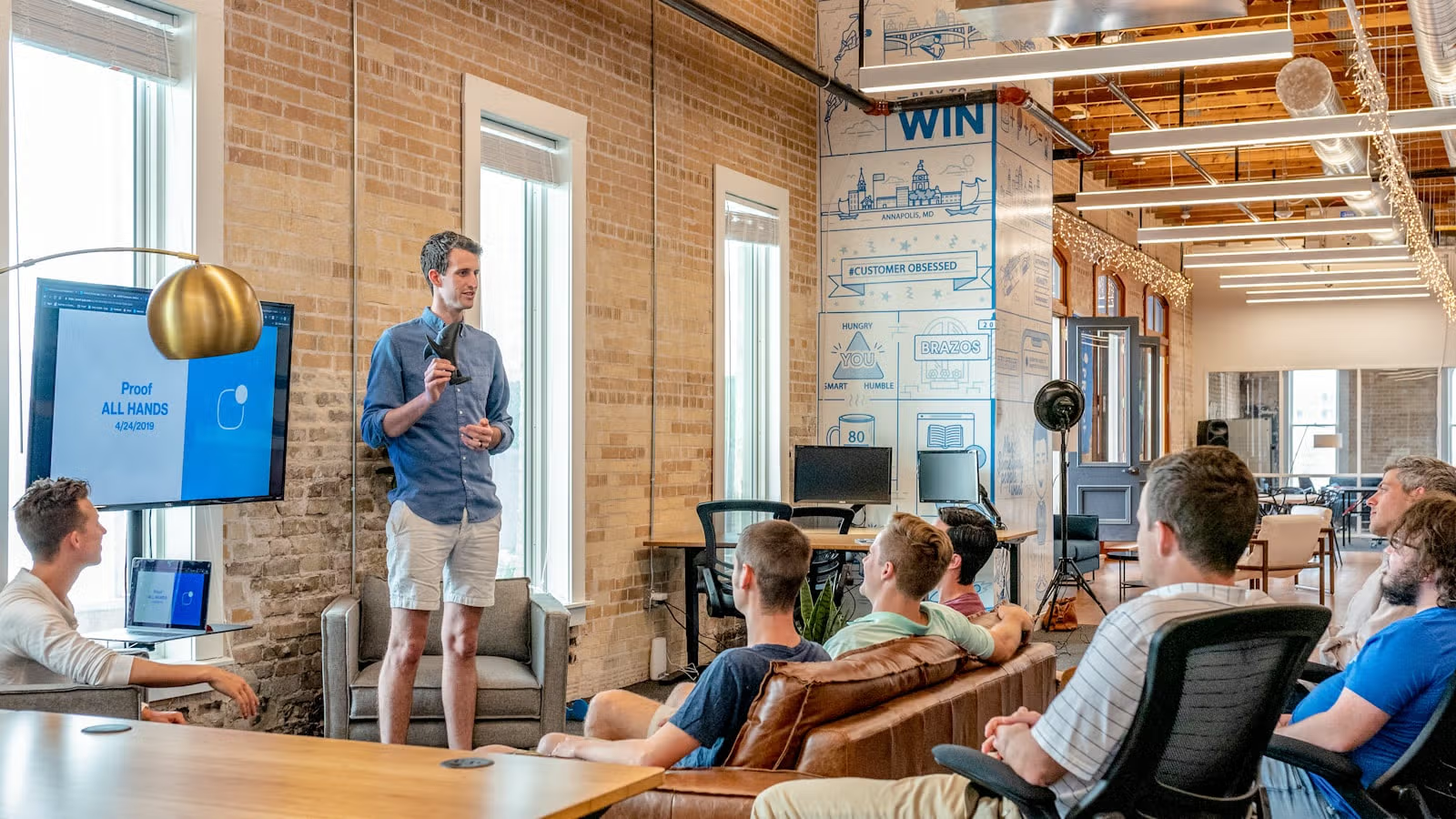
A freelancer at a small desk with a laptop and notebook, just starting a side hustle

Quick Answer

You don't need an LLC, a logo or a website to start a side hustle, you need a skill, one client and a checking account. Six service-based hustles that can be launched this weekend with nothing but a laptop and a few free evenings, plus the exact 7-day plan to get your first paying customer.

Key Takeaways

  • You can launch a service-based side hustle for under $50 by leaning on free tools (Notion portfolio, Wave invoicing, free business checking).
  • Pick the hustle with the shortest path from your existing skill to a paying customer, not the highest-ceiling option.
  • Send 15 personalised outreach messages in week one; this single behaviour separates earners from never-launched hustles.
  • Start at $40/hr for non-technical work and $60/hr for technical work, then raise 15–25% every five projects.
  • Set aside 25–30% of every dollar earned for taxes from day one, the IRS treats self-employment income very differently from W-2 wages.

Key personal finance Statistics

  • According to Bankrate Side Hustle Survey 2024, 44% of side-hustlers say they started theirs to pay regular monthly bills, not to build a business.

  • According to Upwork Freelance Forward 2024, the median time-to-first-dollar for a service-based side hustle is 14 days when the hustler does targeted outreach, vs. 60+ days when they wait for inbound.

  • According to IRS Self-Employment Tax, self-employment tax of 15.3% kicks in on every dollar of net profit above $400/year.

  • According to Upwork Freelance Forward 2024, 60 million Americans (38% of the US workforce) did freelance work in 2024.

What 'zero capital' actually means

Zero capital here means under $50 of out-of-pocket spend in the first 30 days, and zero spend on tools you don't already own. No course, no coach, no Squarespace site, no business cards. The point is to prove the hustle works before any money flows the wrong direction.

The trade you're making instead of money is time. Expect to spend 8–15 hours in week one on outreach, portfolio assembly and pricing research before the first dollar arrives. That hour bank is the only real cost.

The six hustles that genuinely need $0

  • Freelance writing or copy editing for small businesses, blogs and SaaS companies.
  • Virtual assistant work, calendar management, inbox triage, simple research, travel booking.
  • Bookkeeping for sole proprietors and Etsy sellers, if you're already comfortable in spreadsheets.
  • Online tutoring in a subject you scored 90th-percentile in during high school or college.
  • Social-media management for one-location local businesses (restaurants, salons, gyms).
  • Resume and LinkedIn rewrites, $150–$400 per package, sold one at a time on LinkedIn.

Pick the right one in 10 minutes

Don't pick the highest-paying option, pick the one with the shortest path from 'I can do this' to 'someone will pay me for this'. Two questions get you there.

Question one: what task at your current or last job did colleagues regularly ask for your help with? That is your skill arbitrage, you're already proven at it. Question two: which group of small-business owners do you have informal access to (friends, alumni group, religious community, neighbours)? That's your first ten outreach targets, and the only outreach list that converts in week one.

The 7-day launch plan

  1. Day 1 — Pick the hustle and write a one-sentence offer ('I write 800-word blog posts for B2B SaaS companies for $200 each, three-day turnaround').
  2. Day 2 — Assemble a 3-piece portfolio. If you've never been paid for the work, write three sample pieces this evening. Host them on a free Notion page.
  3. Day 3 — Set up a free Lili or Novo business checking account. Get a free PayPal Business account. Bookmark Wave Accounting (free invoicing).
  4. Day 4 — Write your outreach message. Personalised first line + offer + Notion link + soft ask ('happy to start with a small paid trial'). Keep it under 90 words.
  5. Day 5 — Send the message to 15 people. 10 warm contacts (former colleagues, friends-of-friends), 5 cold (small businesses you already use).
  6. Day 6 — Follow up with anyone who opened but didn't reply. Don't apologise for following up, that's the move that loses the gig.
  7. Day 7 — Take the first 'yes', send a written quote (one paragraph, a price, and a delivery date), invoice 50% upfront via Wave, deliver.

Pricing in the first 90 days

Underpricing is the standard rookie mistake. The fix: pick a starting hourly rate of $40/hr for non-technical work, $60/hr for technical (bookkeeping, copywriting, social media). Multiply by realistic hours to quote the project, not by the cheap freelancer you saw on Fiverr.

Raise your rate 15–25% every five completed projects. Existing clients keep the old rate for 60 days, new ones get the new one. By project 20 you should be at roughly 1.6× your week-one rate, with the same work.

What 90 days looks like if you actually do it

A realistic curve: month one = 1–3 clients, $200–$800 net. Month two = 3–5 clients, $600–$1,800 net. Month three = a small repeat-client base, $1,000–$3,000 net, with one or two clients on monthly retainer.

If you're still at $0 after 30 days, the problem is almost never the skill, it's that you sent fewer than 15 outreach messages. Sending 50 fixes it in week five.

More Personal Finance Guides

People also ask

Do I need an LLC before I take my first client?

No. A sole proprietorship is legal in all 50 states with zero paperwork, just use your SSN on the W-9. Form an LLC once you're netting $25K+ a year or doing in-person work with real liability exposure.

What if I have no portfolio?

Write three sample pieces, or do the work for one friend or charity for free in exchange for a written testimonial. A 3-piece portfolio assembled in an evening converts at roughly the same rate as a 30-piece portfolio for first clients.

Should I quit my day job to focus on the hustle?

Not for at least 12 months, and not until the hustle has matched your day-job after-tax income for a year. Health insurance alone usually adds $400–$1,200/month to your real expense base when you go solo.

How do I find my first ten outreach targets?

Open LinkedIn, filter to 'connections' + 'small business owner' + your city. The first ten people you already know who own anything are your launch list, conversion rates from warm outreach run 5–10× cold.

What's the single biggest mistake first-time hustlers make?

Spending the first month building a website, logo and brand instead of sending outreach. The website doesn't bring you clients in year one; targeted outreach does.

What's the right order to fix my finances?

(1) $1,000 starter emergency fund, (2) capture the 401(k) match, (3) pay off high-APR credit-card debt, (4) build 3–6 months emergency fund, (5) max IRA + HSA, (6) increase 401(k) toward the annual cap, (7) taxable brokerage.

How much of my income should I save?

The standard target is 20% of gross across all forms of saving — emergency fund, retirement, sinking funds, taxable. Below 10% is under-saving for retirement; above 30% is high-income or FIRE-pursuing.

What's the 50/30/20 rule?

A budgeting framework that splits take-home pay into 50% needs, 30% wants, 20% savings + extra debt. Coined by Elizabeth Warren in 2005. Works as a percentage check, not a category-by-category plan.

Frequently Asked Questions

Do I need an LLC before I take my first client?
No. A sole proprietorship is legal in all 50 states with zero paperwork, just use your SSN on the W-9. Form an LLC once you're netting $25K+ a year or doing in-person work with real liability exposure.
What if I have no portfolio?
Write three sample pieces, or do the work for one friend or charity for free in exchange for a written testimonial. A 3-piece portfolio assembled in an evening converts at roughly the same rate as a 30-piece portfolio for first clients.
Should I quit my day job to focus on the hustle?
Not for at least 12 months, and not until the hustle has matched your day-job after-tax income for a year. Health insurance alone usually adds $400–$1,200/month to your real expense base when you go solo.
How do I find my first ten outreach targets?
Open LinkedIn, filter to 'connections' + 'small business owner' + your city. The first ten people you already know who own anything are your launch list, conversion rates from warm outreach run 5–10× cold.
What's the single biggest mistake first-time hustlers make?
Spending the first month building a website, logo and brand instead of sending outreach. The website doesn't bring you clients in year one; targeted outreach does.

Go deeper

More to read in Personal Finance

Get Weekly Money Tips Straight to Your Inbox

Join thousands of readers getting practical finance advice every week. Free.

No spam. Unsubscribe anytime.